Energy changes forms without loss or gain. The law of conservation of energy states that the total energy of an isolated system remains constant—it is said to be conserved over time.
Energy cannot be created or destroyed, but it can change forms.
- Chemical energy is converted to kinetic energy in the explosion of a stick of dynamite.
- A microwave oven converts electrical energy into light energy and then into thermal energy.
- As an object falls the gravitational potential energy of position is converted to kinetic energy.
- Chemical energy stored in methane is burned to form thermal energy.
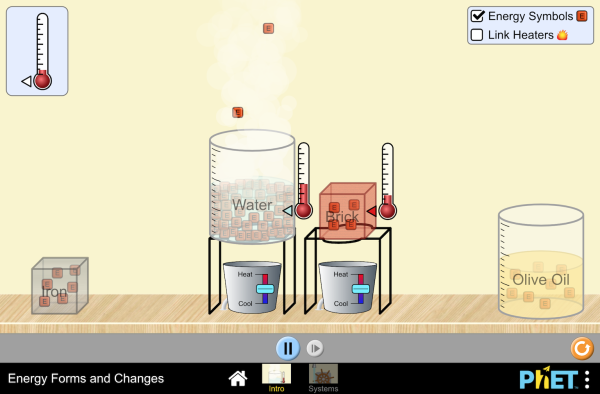
| Click to Run |
Forms of Energy
Physicists have found methods for measuring energy in many different forms.
We will focus on mechanical energy, because it is easier to measure. Mechanical energy is a class of energy that includes all macroscopic energy that comes from an object's motion or position.
Mechanical energy can be divided into kinetic and potential. Kinetic energy comes from the motion of an object, while potential energy comes from its position.
| Type of energy | Description |
|---|---|
| Mechanical | macroscopic kinetic and potential energies that are determined by position and velocity |
| Kinetic | energy from the motion of a body |
| Thermal | kinetic energy from the microscopic motion of particles |
| Potential | energy from the position of a body |
| Gravitational | potential energy from gravitational fields |
| Elastic | potential energy due to the deformation of a material exhibiting a restorative force |
| Mechanical waves | kinetic and potential energy in an elastic material due to a propagated deformational wave |
| Electric | potential energy from electric fields |
| Magnetic | potential energy from magnetic fields |
| Light | potential energy propagated by electromagnetic waves |
| Chemical | potential energy from chemical bonds |
| Nuclear | potential energy that binds protons and neutrons to form the atomic nucleus |
| Chromodynamic | potential energy that binds quarks to form protons and neutrons |
| Mass | potential energy stored as an object's mass |
| Dark Energy | a theoretical repulsive force that counteracts gravity and causes the universe to expand at an accelerating rate |
Work
Work measures the transfer of energy to a
different form.
Work is only done when a force causes an object to change position.
$$W = F \Delta x \cos\theta$$
\(W\) = work, change in energy [J, joules, kg m²/s²]\(F\) = force [N, newtons, kg m/s²]
\(\Delta x\) = displacement [m]
\(\theta\) = angle between applied force and displacement
F cos θ returns the component of the force vector in the same direction as the displacement vector.
- An elevator lifting a person.
- Pedaling a moving bike.
- Pushing a box across the floor.
- A car skidding to a stop.
- Pushing a stationary wall.
- A ball rolling on flat frictionless ground.
Example: Which of these example are actually doing work?
solution
Work is only done when a force causes an object to change position.
- An elevator lifting an person is work.
- Pedaling a moving bike is work.
- Pushing a box across the floor is work.
- A car skidding to a stop is work.
- Pushing a stationary wall is not work.
- A ball rolling on flat frictionless ground is not work.
solution
$$W = F\Delta x\cos\theta$$ $$W = (100)(200)\cos(30)$$ $$W = (100)(200)(0.866)$$ $$W = 17\,320\, \mathrm{J}$$solution
$$W = F\Delta x\cos\theta$$ $$W = (10)(2)\cos(0)$$ $$W = (10)(2)(1)$$ $$W = 20\, \mathrm{J}$$solution
The force to lift must be slightly larger than the force of gravity.
$$F_{g} = mg$$$$W = F\Delta x\cos\theta$$ $$W = (mg)\Delta x\cos\theta$$ $$W = (2085)(9.8)(2.5)\cos(0)$$ $$W = 51082.5\, \mathrm{J}$$
Kinetic Energy
Kinetic energy is the energy objects have from motion.
derivation of kinetic energy
$$v^2 = u^2 +2a\Delta x$$
Kinetic energy is defined as relative to zero velocity, so set the initial velocity to zero.
$$v^2 = 2a\Delta x$$ $$a\Delta x =\frac{v^2}{2}$$ $$ma\Delta x =\tfrac{1}{2}mv^2 $$ $$F\Delta x =\tfrac{1}{2}mv^2 $$ $$W = \tfrac{1}{2}mv^2$$Kinetic energy is the same as the work required to bring a mass to a speed.
$$K =\tfrac{1}{2}mv^2$$$$K = \tfrac{1}{2} mv^{2}$$
\(K\) = kinetic energy [J, joules]\(m\) = mass [kg]
\(v\) = velocity [m/s]
Energy has units of joules in the metric system. 1 joule is the same as a 2 kg mass moving at 1 m/s.
Energy is a scalar. It has no direction. Not having to work with vectors can make solving 2-D and 3-D problems much easier.
Zoe has a mass of 20 kg. She is 0.56 meters tall with reddish fur.
solution
$$KE = \tfrac{1}{2}mv^{2}$$ $$K = \tfrac{1}{2}(20)(5)^{2}$$ $$K = 250 \, \mathrm{J}$$solution
$$K = \tfrac{1}{2}mv^{2}$$ $$K = \tfrac{1}{2}(20)(-5)^{2}$$Energy is a scalar so direction doesn't matter. The negative sign on the velocity goes away because it is squared, and we get the same answer when she runs left or right.
$$K = 250 \, \mathrm{J}$$solution
$$ 176\,\mathrm{lbs} \left(\frac{ 1\,\mathrm{kg} }{ 2.2\,\mathrm{lbs} }\right) = 80\,\mathrm{kg} $$$$K = \tfrac{1}{2}mv^{2}$$ $$100 = \tfrac{1}{2}(80)v^{2}$$ $$100 = (40)v^{2}$$ $$2.5 = v^{2}$$ $$1.58 \mathrm{\tfrac{m}{s}} = v$$
That's about walking speed. It takes about 100 J to accelerate a person from rest to walking speed.
Potential Energy
Potential energy is stored energy from the position of an object.
Examples of potential energy:
How could each of these potential energies convert into kinetic energy?
Gravitational Potential Energy
If you drop a massive object, it will gain kinetic energy as it falls. We call the potential for the energy of its position to turn into kinetic energy gravitational potential energy. We revisit this topic in the unit on gravity.
derivation of gravitational potential energy
Gravitational energy can be calculated with the work equation.
$$W = F\Delta x\cos\theta$$As an object falls the force of gravity pulls the object vertically down.
$$F_{g} = mg$$ $$W = mg\Delta x\cos\theta$$The displacement is vertical so lets call it height: h.
$$W = mgh\cos\theta$$The force of gravity and the height are pointed in the same direction, so cos(0)=1.
$$W = mgh$$We now have a nice equation for the energy that comes from the work of lifting an object.
$$U_{g} = mgh$$
\(U_g\) = gravitational potential energy [J, joules]\(m\) = mass [kg]
\(g\) = acceleration from gravity, 9.8 on Earth [m/s²]
\(h\) = height [m]
Height is the tricky part of gravitational potential energy. Where is height zero? The ground floor can be the zero point, or the floor of the basement or the top of a table, or any point.
answer
They are all correct, but the red one seems the least complex.
Unlike kinetic energy, gravitational potential energy isn't consistent. Changes in gravitational potential are consistent, but not absolute values.
solution
$$\text{6th story - 1st story = 5 stories} $$ $$ \left(5\,\mathrm{story} \right) \left(\frac{3 \, \mathrm{m}} {1 \, \mathrm{story}}\right) = 15 \, \mathrm{m}$$$$\Delta U_{g} = mgh_f-mgh_i$$ $$\Delta U_{g} = (100)(9.8)(15)-(100)(9.8)(0)$$
Since we set height to be zero at the start we know the initial energy is zero.
$$\Delta U_{g} = (100)(9.8)(15)$$ $$\Delta U_{g} = 14700 \, \mathrm{J}$$solution
Unlike the equations of motion, gravitational potential energy is path independent. Path doesn't show up in the equation. We only need to know the displacement, not how the mass got to the place.
All the paths lead to the same increase in gravitational potential energy.
convert ft to m
solution
$$-400\,\mathrm{ft}\left(\frac{0.3048\,\mathrm{m}}{1\,\mathrm{ft}}\right) = -122\,\mathrm{m}$$We know the initial potential energy is zero because of how we made the diagram.
$$\Delta U_{g} = mgh_f-mgh_i$$ $$\Delta U_{g} = mgh_f$$ $$\Delta U_{g} = (80.0)(9.8)(-122)$$ $$\Delta U_{g} = -95648\,\mathrm{J}$$Hooke's Law
When some solids are deformed a small amount they will return to their original shape. Hooke's law is an approximation of the restoring force that counters the deformation.
Metal springs are a good example of Hooke's law. A spring has a force that will bring it back to its original length. Too much deformation can permanently warp a metal spring and make Hooke's law invalid.
$$F = -k x$$
\(F\) = restoring elastic force [N, newtons, kg m/s²] vector\(k\) = spring constant [kg/s², N/m]
\(x\) = displacement from equilibrium [m] vector
The spring constant k is different for every spring. Sometimes when you buy a spring the constant will be listed, but we can also measure it directly.
The spring force is always directed back towards the equilibrium point. This is true if you compress or stretch the spring.
answer
The red one is correctly drawn. Displacement is defined as the distance from equilibrium for the spring only.
solution
$$ x= \mathrm{80\,(m)m = 80\left(\frac{1}{1000}\right)m =0.08 \, m}$$$$F= -k x$$ $$F= -(0.4 \, \mathrm{\tfrac{kg}{s^2}})(0.08 \, \mathrm{m})$$ $$F= -0.032 \, \mathrm{N}$$
hmmm, why is the force negative. We know the force should point right. It needs to be positive. Oh, the displacement points left. It should be negative.
$$F= -(0.4 \, \mathrm{\tfrac{kg}{s^2}})({-0.08 \, \mathrm{m}})$$ $$F= 0.032 \, \mathrm{N}$$solution
$$x= \mathrm{40\,(c)m = 40\left(\frac{1}{100}\right)m =0.4 \, m}$$$$F= -k x$$ $$-100=-k(0.4)$$ $$\frac{-100}{-0.4}=k$$ $$250 \mathrm{\tfrac{kg}{s^2}} = k$$
Elastic Potential Energy
We can convert our equation for the elastic force into energy.
derivation of elastic potential energy
The energy stored in an elastic material can be calculated with the equation for work and some calculus.
$$W = F x\cos\theta$$The elastic force and the displacement are always at 0 degrees.
$$W = F x$$ The force is the elastic force. $$F = -k x$$We can't directly replace F with -kx in the work equation because the force changes over the displacement.
$$F=0 \quad\text{at}\quad x=0$$ $$F=-k (5) \quad\text{at}\quad x=5$$ $$F=-k (10) \quad\text{at}\quad x=10$$We need to use an operation from calculus called an integral. The integral will find the area of F times x, which equals work.
$$W = \int_{0}^{x} k x \ dx$$ $$W = \tfrac{1}{2} kx^2 $$ $$U_s = \tfrac{1}{2}kx^2 $$$$U_{s} = \tfrac{1}{2}kx^{2}$$
\(U_s\) = elastic/spring potential energy [J, joules, kg m²/s²]\(k\) = spring constant [kg/s², N/m]
\(x\) = displacement [m] vector
Elastic potential energy is equal to the work required to bring a spring to a position. Hooke's law is a good approximation until the spring get stretched too much and deformed.
How does the spring constant affect the behavior of the spring?
How does mass affect the behavior of the spring?
solution
$$U_{s} = \tfrac{1}{2}kx^{2}$$ $$U_{s} = \tfrac{1}{2} (7 \,\mathrm{\tfrac{kg}{s^2}})(3\,\mathrm{m})^{2}$$ $$U_{s} = 31.5 \, \mathrm{kg \frac{m^2}{s^2}}$$ $$U_{s} = 31.5 \, \mathrm{J}$$solution
$$200 \, \mathrm{(c)m} = \mathrm{200\left(\frac{1}{100}\right)m = 2\,m}$$$$U_{s} = \tfrac{1}{2}kx^{2}$$ $$U_{s} = \tfrac{1}{2} (0.3 \,\mathrm{\tfrac{kg}{s^2}})(2\,\mathrm{m})^{2}$$ $$U_{s} = 0.6 \, \mathrm{J}$$
Assume the spring is at rest.